Mirza Ghalib Poetry in Urdu: Life, Shayari and Famous Ghazals
- Language
- Urdu
About this novel
Read Mirza Ghalib shayari in Urdu: 12 famous sher with Roman Urdu and English translation, plus his life in Agra and Delhi and his beloved letters.
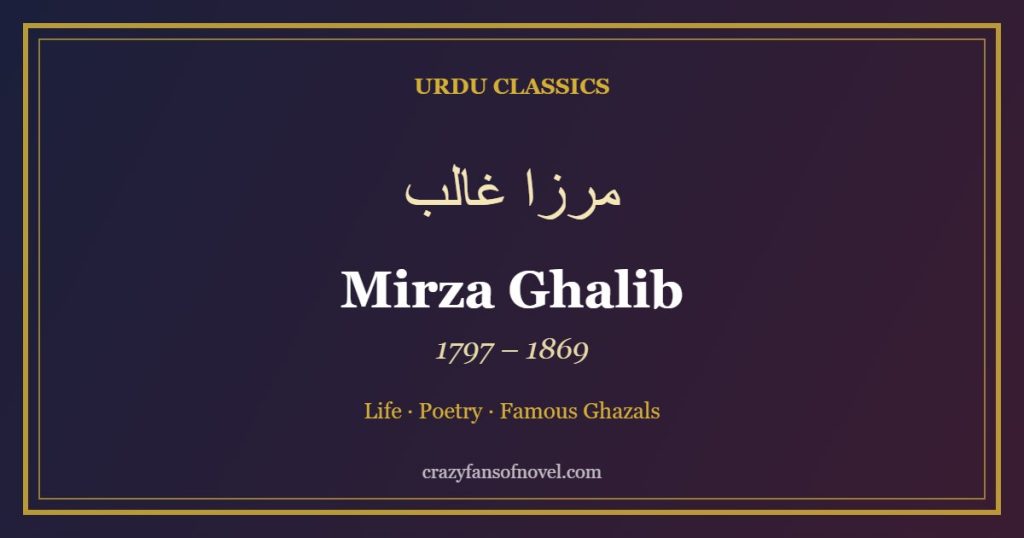
Mirza Ghalib (مرزا غالب), born Mirza Asadullah Beg Khan, is the most celebrated poet of the Urdu language. More than 150 years after his death, his couplets are quoted in everyday conversation, sung by the greatest singers of South Asia and studied in every Urdu classroom.
In this guide
Life
Ghalib was born in Agra in 1797 into a family of Turkish descent and moved to Delhi as a young man, where he spent the rest of his life. He wrote first under the pen name Asad and later Ghalib (“dominant”).
He became connected to the court of the last Mughal emperor, Bahadur Shah Zafar, who gave him the titles Dabir-ul-Mulk and Najm-ud-Daula; he served as the court’s poetry tutor and royal historian. Yet for much of his life he struggled with money and fought a long battle over his family pension.
Ghalib lived through the uprising of 1857 and saw the destruction of the Delhi he loved and the fall of the Mughal court. He died in Delhi in 1869 and is buried near the dargah of Nizamuddin Auliya. His house in Delhi’s Ballimaran is now a museum.
His poetry
Ghalib wrote in both Persian and Urdu. His Persian work is much larger, but his fame rests on his Urdu ghazals, collected in his Diwan. He took the ghazal beyond the traditional subject of unhappy love and used it to explore philosophy, faith, doubt, fate and the human condition, often with irony and wit.
Mirza Ghalib shayari: 12 famous sher in Urdu with English translation
Among all the poems by Ghalib, these are twelve of the most quoted couplets (sher), each in Urdu script, in Roman Urdu and with a plain English translation of our own. Ghalib died in 1869, so his poetry is in the public domain.
1. Hazaron khwahishen aisi ke har khwahish pe dam nikle
ہزاروں خواہشیں ایسی کہ ہر خواہش پہ دم نکلے
بہت نکلے مرے ارمان لیکن پھر بھی کم نکلے
Hazaron khwahishen aisi ke har khwahish pe dam nikle
Bahut nikle mere arman lekin phir bhi kam nikle
A thousand desires, each one worth dying for; many of my wishes came true, yet they were still too few.
2. Ye na thi hamari qismat ke visal-e-yaar hota
یہ نہ تھی ہماری قسمت کہ وصالِ یار ہوتا
اگر اور جیتے رہتے یہی انتظار ہوتا
Ye na thi hamari qismat ke visal-e-yaar hota
Agar aur jeete rehte yahi intezar hota
It was never my fate to be united with my beloved; had I lived longer, I would only have gone on waiting.
3. Dil-e-nadan tujhe hua kya hai
دلِ ناداں تجھے ہوا کیا ہے
آخر اس درد کی دوا کیا ہے
Dil-e-nadan tujhe hua kya hai
Aakhir is dard ki dawa kya hai
O foolish heart, what has happened to you? What, after all, is the cure for this pain?
4. Koi ummeed bar nahin aati
کوئی امید بر نہیں آتی
کوئی صورت نظر نہیں آتی
Koi ummeed bar nahin aati
Koi surat nazar nahin aati
No hope is fulfilled; no way out can be seen.
5. Hum ko maloom hai jannat ki haqeeqat lekin
ہم کو معلوم ہے جنت کی حقیقت لیکن
دل کے خوش رکھنے کو غالبؔ یہ خیال اچھا ہے
Hum ko maloom hai jannat ki haqeeqat lekin
Dil ke khush rakhne ko Ghalib ye khayal achha hai
I know the truth about paradise, but, Ghalib, it is a pleasant thought to keep the heart happy.
6. Hain aur bhi duniya mein sukhan-war bahut achhe
ہیں اور بھی دنیا میں سخن ور بہت اچھے
کہتے ہیں کہ غالبؔ کا ہے اندازِ بیاں اور
Hain aur bhi duniya mein sukhan-war bahut achhe
Kehte hain ke Ghalib ka hai andaz-e-bayan aur
There are many other fine poets in the world, but people say Ghalib has a way of saying things all his own.
7. Ishrat-e-qatra hai darya mein fana ho jana
عشرتِ قطرہ ہے دریا میں فنا ہو جانا
درد کا حد سے گزرنا ہے دوا ہو جانا
Ishrat-e-qatra hai darya mein fana ho jana
Dard ka had se guzarna hai dawa ho jana
The joy of a drop is to lose itself in the river; when pain goes beyond all limits, it becomes its own cure.
8. Na tha kuchh to Khuda tha, kuchh na hota to Khuda hota
نہ تھا کچھ تو خدا تھا، کچھ نہ ہوتا تو خدا ہوتا
ڈبویا مجھ کو ہونے نے، نہ ہوتا میں تو کیا ہوتا
Na tha kuchh to Khuda tha, kuchh na hota to Khuda hota
Duboya mujh ko hone ne, na hota main to kya hota
When there was nothing, God was there; had nothing existed, God would still be. My own being has drowned me; had I not been, what would I have been?
9. Ragon mein daudte phirne ke hum nahin qaail
رگوں میں دوڑتے پھرنے کے ہم نہیں قائل
جب آنکھ ہی سے نہ ٹپکا تو پھر لہو کیا ہے
Ragon mein daudte phirne ke hum nahin qaail
Jab aankh hi se na tapka to phir lahu kya hai
I am not impressed by blood that merely runs through the veins; if it does not fall from the eyes as tears, what kind of blood is it?
10. Bas ke dushwar hai har kaam ka aasan hona
بس کہ دشوار ہے ہر کام کا آساں ہونا
آدمی کو بھی میسر نہیں انساں ہونا
Bas ke dushwar hai har kaam ka aasan hona
Aadmi ko bhi muyassar nahin insan hona
It is hard for any task to become easy; even a man does not easily become truly human.
11. Ranj se khugar hua insan to mit jata hai ranj
رنج سے خوگر ہوا انساں تو مٹ جاتا ہے رنج
مشکلیں مجھ پر پڑیں اتنی کہ آساں ہو گئیں
Ranj se khugar hua insan to mit jata hai ranj
Mushkilen mujh par padin itni ke aasan ho gayin
When a person grows used to sorrow, the sorrow fades; so many hardships fell on me that they became easy.
12. Dard minnat-kash-e-dawa na hua
درد منت کشِ دوا نہ ہوا
میں نہ اچھا ہوا، برا نہ ہوا
Dard minnat-kash-e-dawa na hua
Main na achha hua, bura na hua
My pain never had to beg a favour from medicine; I was not cured, and that did me no harm.
His letters
Ghalib’s letters (khutoot) are as famous as his poetry. He wrote to friends in a relaxed, conversational style, as if talking to them face to face, and in doing so helped shape simple, modern Urdu prose. They are also a moving record of Delhi before and after 1857.
Legacy
Ghalib’s ghazals have been sung by many great singers and have appeared in films and television series about his life. He is often called the greatest poet of the Urdu language.
Frequently asked questions
What was Mirza Ghalib’s real name? Mirza Asadullah Beg Khan.
When and where was Ghalib born? In Agra, on 27 December 1797. He died in Delhi on 15 February 1869.
What is Ghalib’s most famous sher? Probably Hazaron khwahishen aisi ke har khwahish pe dam nikle, followed closely by Dil-e-nadan tujhe hua kya hai. Both are given above in Urdu with English translation.
Where is Ghalib buried? In Delhi, near the dargah of Nizamuddin Auliya.
Read more guides in our Urdu Classics section, including Mirat-ul-Uroos, Umrao Jaan Ada and Kafan. For more Urdu poetry, see our list of famous Urdu poets and read Urdu poetry in English (29 famous couplets by Mir, Ghalib, Iqbal and others), Mir Taqi Mir poetry in Urdu with English translation, Allama Iqbal poetry in Urdu with English translation and Shikwa and Jawab-e-Shikwa.