Mir Taqi Mir Poetry in Urdu with English Translation
- Language
- Urdu
About this novel
Read Mir Taqi Mir poetry in Urdu: 13 famous sher with Roman Urdu and English translation, and his life in Delhi and Lucknow. Mir, also written Meer Taqi Meer, is the poet Urdu readers call Khuda-e-Sukhan, the god of poetry.
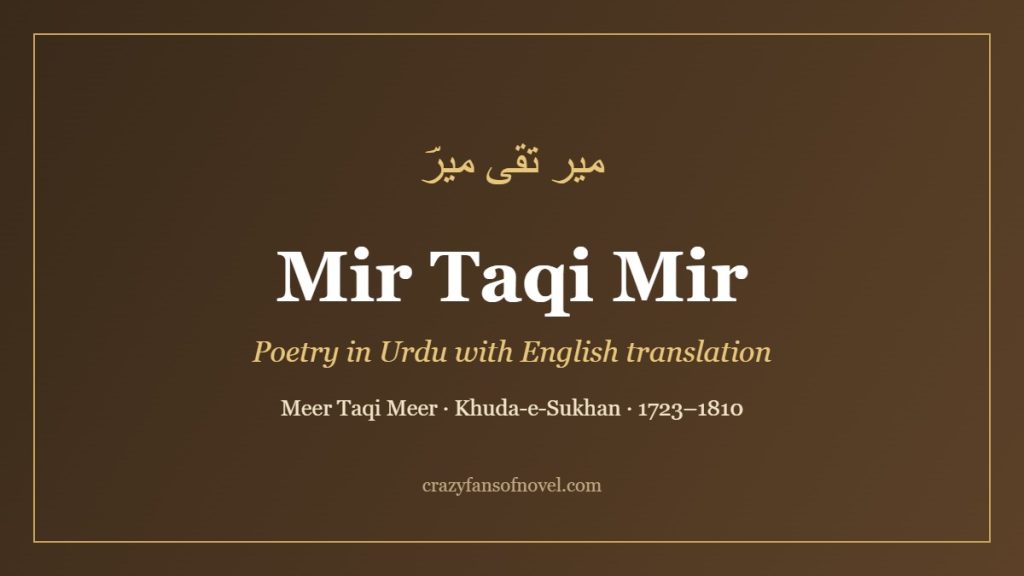
Mir Taqi Mir (میر تقی میرؔ), also spelled Meer Taqi Meer, is the great master of the Urdu ghazal. He lived through the slow fall of Mughal Delhi in the 18th century, and his simple, heartbroken couplets about love, loss and a ruined city are still quoted more than 200 years later.
In this guide
Mir Taqi Mir: quick facts
- Name: Mir Muhammad Taqi, pen name Mir
- Also spelled: Meer Taqi Meer
- Born: 1723, Agra (then called Akbarabad)
- Died: September 1810, Lucknow
- Known as: Khuda-e-Sukhan, the god of poetry
- Famous for: the Urdu ghazal
- Main work: Kulliyat-e-Mir, six Urdu divans
Life of Mir Taqi Mir
Mir was born in Agra in 1723. His father was a deeply religious man with a large following of Sufi disciples, and his teachings of love and devotion shaped Mir for the rest of his life. His father died while Mir was still a boy, and soon afterwards he left Agra for Delhi to finish his education and look for patrons.
Delhi in the 18th century was a city in decline. The Mughal empire was weakening, and the city was attacked and looted again and again, including by Nadir Shah in 1739 and Ahmad Shah Abdali. Mir saw much of this destruction for himself, and the pain of a ruined city runs through his poetry.
In 1782, already a famous poet, Mir accepted an invitation from Nawab Asaf-ud-Daula and moved to Lucknow. He spent the last part of his life there, proud, sensitive and often unhappy, and grew distant from the court. He died in Lucknow in September 1810. The original marker on his grave was lost when railway lines were laid over the site; a memorial was later built near the place where he is buried.
His poetry and style
Mir wrote mainly ghazals, but also masnavis (long narrative poems), qasidas and other forms. His language is close to the everyday speech of Delhi, so his best couplets feel simple and natural, yet they carry a great depth of feeling. Sorrow, longing, unanswered love and the sadness of a dying world are his main themes, and readers often describe his poetry as the voice of a broken heart.
That is why many critics call him the greatest Urdu ghazal poet, and why Urdu readers gave him the title Khuda-e-Sukhan, the god of poetry.
Mir Taqi Mir shayari: 13 famous sher in Urdu with English translation
These are thirteen of the most quoted couplets (sher) by Meer Taqi Meer, each in Urdu script, in Roman Urdu and with a plain English translation of our own. Mir died in 1810, so his poetry is in the public domain.
1. Patta patta boota boota haal hamara jaane hai
پتا پتا بوٹا بوٹا حال ہمارا جانے ہے
جانے نہ جانے گل ہی نہ جانے باغ تو سارا جانے ہے
Patta patta boota boota haal hamara jaane hai
Jaane na jaane gul hi na jaane baagh to saara jaane hai
Every leaf and every bush knows the state I am in; only the rose does not know, though the whole garden does.
2. Nazuki us ke lab ki kya kahiye
نازکی اس کے لب کی کیا کہیے
پنکھڑی ایک گلاب کی سی ہے
Nazuki us ke lab ki kya kahiye
Pankhudi ek gulab ki si hai
How can I describe the softness of her lips? They are like the petal of a rose.
3. Dikhai diye yun ke bekhud kiya
دکھائی دیے یوں کہ بے خود کیا
ہمیں آپ سے بھی جدا کر چلے
Dikhai diye yun ke bekhud kiya
Hamein aap se bhi juda kar chale
You appeared in such a way that I lost myself; you left me parted even from my own self.
4. Aag the ibtida-e-ishq mein hum
آگ تھے ابتدائے عشق میں ہم
اب جو ہیں خاک انتہا ہے یہ
Aag the ibtida-e-ishq mein hum
Ab jo hain khaak intiha hai ye
At the start of love I was fire; now I am ashes, and this is where it ends.
5. Rah-e-door-e-ishq mein rota hai kya
راہِ دورِ عشق میں روتا ہے کیا
آگے آگے دیکھیے ہوتا ہے کیا
Rah-e-door-e-ishq mein rota hai kya
Aage aage dekhiye hota hai kya
Why weep at the start of love's long road? Wait and see what lies ahead.
6. Ishq ik Mir bhaari patthar hai
عشق اک میرؔ بھاری پتھر ہے
کب یہ تجھ ناتواں سے اٹھتا ہے
Ishq ik Mir bhaari patthar hai
Kab ye tujh na-tawan se uthta hai
Love, Mir, is a heavy stone; how can a weak one like you ever lift it?
7. Mat sahl hamein jaano phirta hai falak barson
مت سہل ہمیں جانو پھرتا ہے فلک برسوں
تب خاک کے پردے سے انسان نکلتے ہیں
Mat sahl hamein jaano phirta hai falak barson
Tab khaak ke parde se insan nikalte hain
Do not take me lightly: the heavens turn for years before a true human being rises from the dust.
8. Yaad us ki itni khoob nahin Mir baaz aa
یاد اس کی اتنی خوب نہیں میرؔ باز آ
ناداں پھر وہ جی سے بھلایا نہ جائے گا
Yaad us ki itni khoob nahin Mir baaz aa
Nadan phir woh ji se bhulaya na jayega
Thinking of her so much is not good for you, Mir; stop, foolish one, or you will never be able to forget her.
9. Hamare aage tera jab kisu ne naam liya
ہمارے آگے ترا جب کسو نے نام لیا
دلِ ستم زدہ کو ہم نے تھام تھام لیا
Hamare aage tera jab kisu ne naam liya
Dil-e-sitam-zada ko hum ne thaam thaam liya
Whenever anyone spoke your name in front of me, I had to hold on tight to my wounded heart.
10. Kin neendon ab tu soti hai ae chashm-e-girya-nak
کن نیندوں اب تو سوتی ہے اے چشمِ گریہ ناک
مژگاں تو کھول شہر کو سیلاب لے گیا
Kin neendon ab tu soti hai ae chashm-e-girya-nak
Mizhgan to khol shehr ko sailaab le gaya
What deep sleep is this, my weeping eye? Open your lashes: the flood of your tears has carried the whole city away.
11. Mere saliqe se meri nibhi mohabbat mein
مرے سلیقے سے میری نبھی محبت میں
تمام عمر میں ناکامیوں سے کام لیا
Mere saliqe se meri nibhi mohabbat mein
Tamaam umr main nakaamiyon se kaam liya
My love lasted only because of my own patience: all my life I made do with failure.
12. Ab to jaate hain butkade se Mir
اب تو جاتے ہیں بت کدے سے میرؔ
پھر ملیں گے اگر خدا لایا
Ab to jaate hain butkade se Mir
Phir milenge agar Khuda laaya
Now, Mir, I leave the house of idols; we will meet again if God brings us together.
13. Mir hum mil ke bahut khush hue tum se pyare
میرؔ ہم مل کے بہت خوش ہوئے تم سے پیارے
اس خرابے میں مری جان تم آباد رہو
Mir hum mil ke bahut khush hue tum se pyare
Is kharabe mein meri jaan tum aabaad raho
Mir, I was so happy to meet you, my dear; may you always flourish in this ruined world, my love.
Mir and Ghalib
Mirza Ghalib, born in Agra in 1797, admired Mir deeply. In one famous couplet Ghalib tells himself that he is not the only master of Urdu poetry, because people say there was once a Mir as well:
ریختے کے تمہیں استاد نہیں ہو غالبؔ
کہتے ہیں اگلے زمانے میں کوئی میرؔ بھی تھا
Rekhte ke tumhi ustad nahin ho Ghalib
Kehte hain agle zamane mein koi Mir bhi tha
You are not the only master of Urdu verse, Ghalib; they say that in an earlier age there was also a Mir.
Read more about him in our guide to Mirza Ghalib shayari.
Books and works
- Kulliyat-e-Mir: his collected Urdu poetry in six divans, with more than 13,000 couplets.
- Zikr-e-Mir: his autobiography, written in Persian.
- Nikat-ush-Shura: a book in Persian about the Urdu poets of his time.
- Faiz-e-Mir: stories of Sufis and faqirs.
- Masnavis: long poems including Mu’amlat-e-Ishq (The Stages of Love) and Khwab-o-Khayal-e-Mir.
His life was also shown in the Pakistani film Mah-e-Mir (2016).
Frequently asked questions
Is it Mir Taqi Mir or Meer Taqi Meer? Both are correct. They are two English spellings of the same Urdu name, میر تقی میر.
When and where was Mir Taqi Mir born? In Agra in 1723. He died in Lucknow in September 1810.
Why is Mir called Khuda-e-Sukhan? Because of the beauty and depth of his ghazals, Urdu readers and poets gave him the title Khuda-e-Sukhan, the god of poetry.
What is Mir Taqi Mir’s most famous sher? Probably Patta patta boota boota haal hamara jaane hai, followed by Nazuki us ke lab ki kya kahiye. Both are given above in Urdu with English translation.
Who was greater, Mir or Ghalib? Readers have argued about this for two centuries. Ghalib himself praised Mir, and most critics call Mir the master of feeling and Ghalib the master of thought.
Read more guides in our Urdu Classics section. For more Urdu poetry, read Urdu poetry in English (famous couplets by Mir, Ghalib, Iqbal and others), sad Urdu poetry, love poetry in Urdu and Allama Iqbal poetry in Urdu with English translation.
Ready to read Mir Taqi Mir Poetry in Urdu with English Translation?