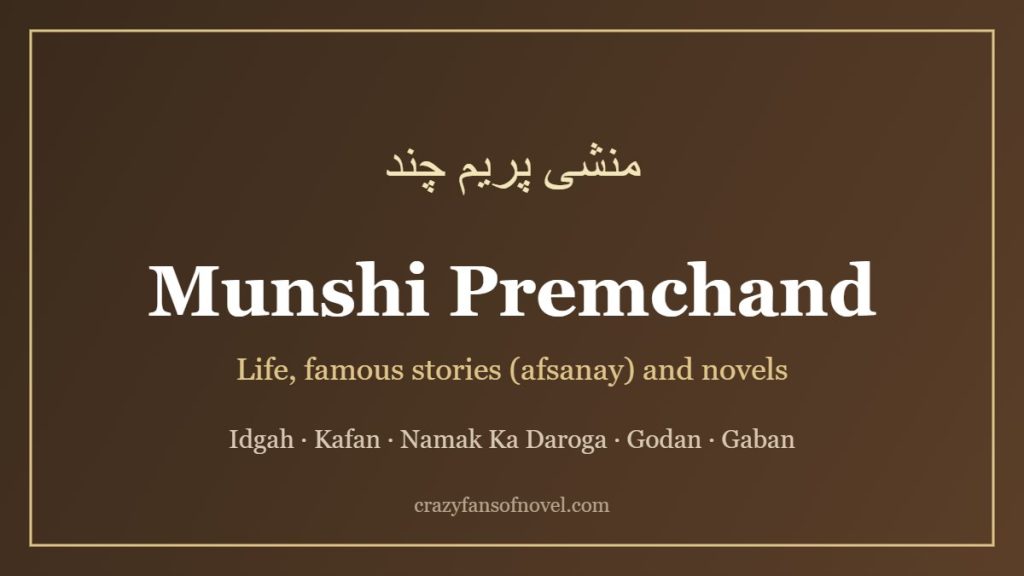
Munshi Premchand: Life, Famous Stories (Afsanay) and Novels
- Language
- Urdu
About this novel
Munshi Premchand was the master story-teller of Urdu and Hindi; read about his life, famous afsanay like Idgah and Kafan, and a list of his novels.
Munshi Premchand (منشی پریم چند, 1880–1936) is the writer who brought ordinary village people, poor farmers, clerks and housewives into Urdu and Hindi fiction. He wrote around 300 short stories (afsanay) and more than a dozen novels, first in Urdu and later mostly in Hindi, and he is still read in schools across Pakistan and India.
This page gives a short life of Premchand, his most famous stories with links to our full guides, and a list of his novels with their Urdu and Hindi titles.
On this page
Munshi Premchand: quick facts
- Real name: Dhanpat Rai Srivastava
- First pen name: Nawab Rai
- Born: 31 July 1880, Lamhi village, near Banaras (Varanasi)
- Died: 8 October 1936, Banaras, after a long illness
- Wrote in: Urdu and Hindi
- Best-known stories: Idgah, Kafan, Namak Ka Daroga, Bade Ghar Ki Beti, Panch Parmeshwar, Shatranj Ke Khiladi
- Best-known novels: Godan, Gaban, Nirmala, Bazaar-e-Husn (Sevasadan)
Life of Munshi Premchand
Dhanpat Rai was born in Lamhi, a village near Banaras, in 1880. His family was not rich, he lost his mother as a child and his father as a young man, and he had to support his family while still studying. He learned Urdu and Persian first, and later worked for many years as a school teacher and schools inspector.
He began writing in Urdu under the name Nawab Rai. His first collection of stories, Soz-e-Watan (“The Pain of the Nation”), published in 1907–08, was full of patriotic feeling. The British authorities called it seditious, and copies of the book were seized and burnt. After this he took a new pen name, Premchand, so that he could keep writing.
In the 1920s he left government service to support the freedom movement and gave his time fully to writing and publishing. In 1930 he started the magazine Hans. In 1936 he was chosen as the first president of the Progressive Writers’ Association at its meeting in Lucknow. He died in Banaras on 8 October 1936, leaving his last novel, Mangalsutra, unfinished.
Famous stories of Munshi Premchand (afsanay)
These are the Premchand stories that are most often read, taught and searched for. Each has its own guide on our site with the story, characters and themes.
- Idgah: little Hamid goes to the Eid fair with three paise and, instead of toys or sweets, buys a pair of tongs so that his grandmother will no longer burn her hands. The most loved children’s story in Urdu and Hindi.
- Kafan (The Shroud): a father and son, too lazy and poor to help a dying woman, spend the money collected for her shroud on drink. One of his last and darkest stories.
- Namak Ka Daroga: an honest salt inspector refuses a bribe from a powerful landlord, and loses his job for it. The full Urdu story is on our page.
- Bade Ghar Ki Beti: a wise daughter-in-law from a rich family saves her husband’s family from breaking apart after a quarrel.
- Panch Parmeshwar: two close friends, Jumman and Algu, each have to judge the other in a village panchayat, and both choose justice over friendship.
- Shatranj Ke Khiladi (The Chess Players): two noblemen of Lucknow are so lost in chess that they hardly notice the British taking over their kingdom. Satyajit Ray made it into a film in 1977.
Other well-known stories include Poos Ki Raat, Bade Bhai Sahab, Do Bailon Ki Katha and Thakur Ka Kuan.
Novels and books of Munshi Premchand
Many of Premchand’s novels were published in both languages, sometimes under different titles. The main ones are:
| Urdu title | Hindi title | About |
|---|---|---|
| Bazaar-e-Husn | Sevasadan | An unhappy marriage, a woman driven to the courtesans’ quarter, and her struggle to rebuild her life |
| Chaugan-e-Hasti | Rangbhoomi | A blind beggar stands up to a factory owner who wants his land |
| Nirmala | Nirmala | A young girl married to a much older widower, and the tragedy that follows |
| Ghaban | Gaban | A young clerk steals to satisfy his wife’s love of jewellery |
| Maidan-e-Amal | Karmabhoomi | Idealism and the freedom movement |
| Gaudan | Godan | His masterpiece (1936): the poor farmer Hori and his lifelong dream of owning a cow |
His Urdu story collections include Soz-e-Watan, Prem Pachisi, Prem Batisi, Khwab-o-Khayal and Wardat. In Hindi, his stories were later collected in the eight volumes of Mansarovar.
Was Premchand an Urdu or a Hindi writer?
Both. Premchand learned Urdu and Persian first and wrote his early stories and novels in Urdu. From around 1915 he began writing more and more in Hindi, partly because Hindi publishers could reach more readers. He often wrote the same story or novel in both languages, so Urdu readers in Pakistan and Hindi readers in India think of him as their own writer.
Frequently asked questions
What was Munshi Premchand’s real name?
Dhanpat Rai Srivastava. He first wrote as Nawab Rai and later as Premchand. “Munshi” is a respectful title, once used for writers, teachers and clerks, that readers added to his name.
When did Premchand die?
He died in Banaras (Varanasi) on 8 October 1936, at the age of 56, after a long illness.
What is Premchand’s most famous story?
Idgah is probably the best known, especially among children. Kafan is often called his finest story by critics.
What is Premchand’s best novel?
Most readers and critics name Godan (Gaudan), his last completed novel, about the hard life of a poor farmer.
Why was Soz-e-Watan banned?
The British government thought its patriotic stories could encourage rebellion, so the book was banned and copies were burnt. This is why Dhanpat Rai stopped using the name Nawab Rai and became Premchand.
Read more in our Urdu Classics section, including Umrao Jaan Ada, Mirat-ul-Uroos and Urdu poetry in English.
Ready to read Munshi Premchand: Life, Famous Stories (Afsanay) and Novels?