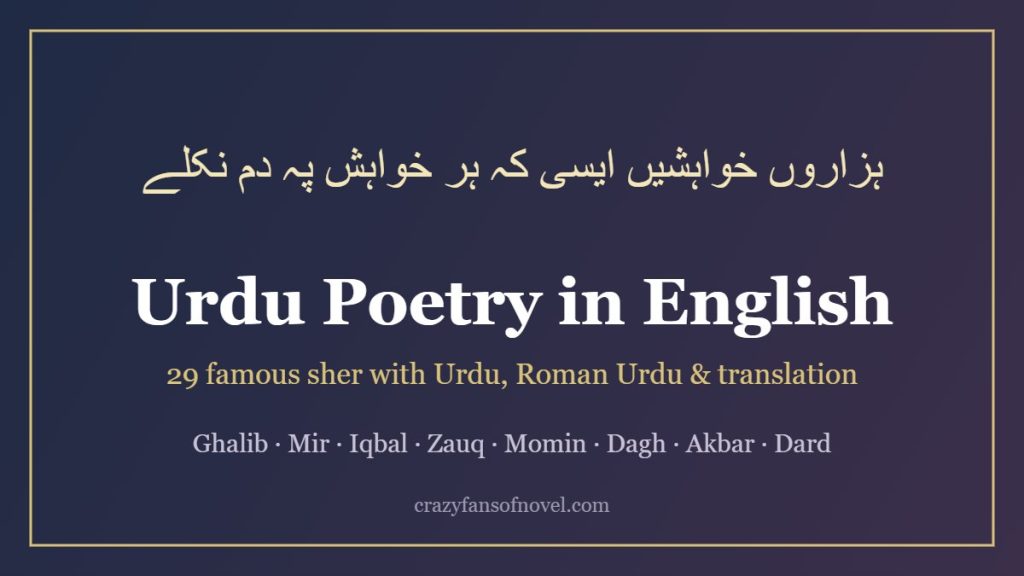
Urdu Poetry in English: 29 Famous Sher with Urdu Text and Translation
- Language
- Urdu
About this novel
Read 29 famous Urdu poetry couplets in English, each with Urdu script and Roman Urdu: love, sad and inspiring sher by Ghalib, Mir, Iqbal and others.
Urdu has one of the richest traditions of poetry in the world, but much of its beauty is hard to share with friends and children who read English better than Urdu. This page collects 29 of the most famous couplets (sher) of classical Urdu poetry. Each one is given in Urdu script, in Roman Urdu so you can read it aloud, and with a plain English translation of our own.
All the poets here lived and died long ago, from Mir Taqi Mir in the 18th century to Allama Iqbal, who died in 1938, so their poetry is in the public domain and free to read and share.
On this page
Love poetry in Urdu with English translation
Love, longing and the beloved are at the heart of the Urdu ghazal. These are some of the best-known lines on love. For 17 more, see our full page of love poetry in Urdu.
ہزاروں خواہشیں ایسی کہ ہر خواہش پہ دم نکلے
بہت نکلے مرے ارمان لیکن پھر بھی کم نکلے
Hazaron khwahishen aisi ke har khwahish pe dam nikle
Bahut nikle mere arman lekin phir bhi kam nikle
A thousand desires, each one worth dying for; many of my wishes came true, yet they were still too few.
— Mirza Ghalib
نازکی اس کے لب کی کیا کہیے
پنکھڑی ایک گلاب کی سی ہے
Nazuki us ke lab ki kya kahiye
Pankhudi ek gulab ki si hai
How can I describe the softness of her lips? They are like the petal of a rose.
— Mir Taqi Mir
پتا پتا بوٹا بوٹا حال ہمارا جانے ہے
جانے نہ جانے گل ہی نہ جانے باغ تو سارا جانے ہے
Patta patta boota boota haal hamara jaane hai
Jaane na jaane gul hi na jaane baagh to saara jaane hai
Every leaf and every bush knows the state I am in; only the rose does not know, though the whole garden does.
— Mir Taqi Mir
تم مرے پاس ہوتے ہو گویا
جب کوئی دوسرا نہیں ہوتا
Tum mere paas hote ho goya
Jab koi doosra nahin hota
You are with me, as it were, whenever no one else is there.
— Momin Khan Momin
خوب پردہ ہے کہ چلمن سے لگے بیٹھے ہیں
صاف چھپتے بھی نہیں سامنے آتے بھی نہیں
Khoob parda hai ke chilman se lage baithe hain
Saaf chhupte bhi nahin saamne aate bhi nahin
What a veil this is: she sits close behind the screen, neither fully hidden nor coming out in front.
— Dagh Dehlvi
غضب کیا ترے وعدے پہ اعتبار کیا
تمام رات قیامت کا انتظار کیا
Ghazab kiya tere waade pe aitbaar kiya
Tamaam raat qayamat ka intezar kiya
What a mistake it was to trust your promise; all night long I waited as if for the Day of Judgement.
— Dagh Dehlvi
دکھائی دیے یوں کہ بے خود کیا
ہمیں آپ سے بھی جدا کر چلے
Dikhai diye yun ke bekhud kiya
Hamein aap se bhi juda kar chale
You appeared in such a way that I lost myself; you left me parted even from my own self.
— Mir Taqi Mir
ترے عشق کی انتہا چاہتا ہوں
مری سادگی دیکھ کیا چاہتا ہوں
Tere ishq ki intiha chahta hoon
Meri sadgi dekh kya chahta hoon
I want the very limit of your love; look at my innocence, see what it is I ask for.
— Allama Iqbal
Sad Urdu poetry (ghamgeen shayari) with English translation
Grief, separation and the shortness of life run through classical Urdu poetry. These sad couplets are among the most quoted. For 14 more, see our page of sad Urdu poetry.
اب تو گھبرا کے یہ کہتے ہیں کہ مر جائیں گے
مر کے بھی چین نہ پایا تو کدھر جائیں گے
Ab to ghabra ke ye kehte hain ke mar jayenge
Mar ke bhi chain na paaya to kidhar jayenge
In despair I now say that I will die; but if I find no peace even in death, where will I go then?
— Shaikh Ibrahim Zauq
زندگی ہے یا کوئی طوفان ہے
ہم تو اس جینے کے ہاتھوں مر چلے
Zindagi hai ya koi toofan hai
Hum to is jeene ke haathon mar chale
Is this life, or some storm? This business of living has all but killed me.
— Khwaja Mir Dard
یہ نہ تھی ہماری قسمت کہ وصالِ یار ہوتا
اگر اور جیتے رہتے یہی انتظار ہوتا
Ye na thi hamari qismat ke visal-e-yaar hota
Agar aur jeete rehte yahi intezar hota
It was never my fate to be united with my beloved; had I lived longer, I would only have gone on waiting.
— Mirza Ghalib
آگ تھے ابتدائے عشق میں ہم
اب جو ہیں خاک انتہا ہے یہ
Aag the ibtida-e-ishq mein hum
Ab jo hain khaak intiha hai ye
At the start of love I was fire; now I am ashes, and this is where it ends.
— Mir Taqi Mir
کوئی امید بر نہیں آتی
کوئی صورت نظر نہیں آتی
Koi ummeed bar nahin aati
Koi surat nazar nahin aati
No hope is fulfilled; no way out can be seen.
— Mirza Ghalib
حال مجھ غم زدہ کا جس جس نے
جب سنا ہوگا رو دیا ہوگا
Haal mujh gham-zada ka jis jis ne
Jab suna hoga ro diya hoga
Whoever heard the story of my grief must surely have wept.
— Khwaja Mir Dard
لائی حیات آئے قضا لے چلی چلے
اپنی خوشی نہ آئے نہ اپنی خوشی چلے
Laai hayat aaye qaza le chali chale
Apni khushi na aaye na apni khushi chale
Life brought me, so I came; death takes me, so I go. I neither came by my own wish nor leave by it.
— Shaikh Ibrahim Zauq
اب تو جاتے ہیں بت کدے سے میرؔ
پھر ملیں گے اگر خدا لایا
Ab to jaate hain butkade se Mir
Phir milenge agar Khuda laaya
Now, Mir, I leave the house of idols; we will meet again if God brings us together.
— Mir Taqi Mir
Inspirational Urdu poetry in English
Allama Iqbal turned Urdu poetry towards hope, courage and self-belief. His lines on khudi (the self) are still quoted to students and young people.
خودی کو کر بلند اتنا کہ ہر تقدیر سے پہلے
خدا بندے سے خود پوچھے بتا تیری رضا کیا ہے
Khudi ko kar buland itna ke har taqdeer se pehle
Khuda bande se khud poochhe bata teri raza kya hai
Raise your self so high that before every turn of fate, God Himself asks you: tell me, what is your wish?
— Allama Iqbal
ستاروں سے آگے جہاں اور بھی ہیں
ابھی عشق کے امتحاں اور بھی ہیں
Sitaron se aage jahan aur bhi hain
Abhi ishq ke imtihan aur bhi hain
There are worlds beyond the stars; love still has more tests ahead.
— Allama Iqbal
تو شاہیں ہے پرواز ہے کام تیرا
ترے سامنے آسماں اور بھی ہیں
Tu shaheen hai parwaz hai kaam tera
Tere saamne aasman aur bhi hain
You are a falcon, and flying is your work; there are more skies in front of you.
— Allama Iqbal
نہیں ہے ناامید اقبالؔ اپنی کشتِ ویراں سے
ذرا نم ہو تو یہ مٹی بہت زرخیز ہے ساقی
Nahin hai na-ummeed Iqbal apni kisht-e-veeran se
Zara nam ho to ye mitti bahut zarkhez hai saqi
Iqbal has not lost hope in his barren field; with a little moisture, this soil is very fertile, O Saqi.
— Allama Iqbal
مت سہل ہمیں جانو پھرتا ہے فلک برسوں
تب خاک کے پردے سے انسان نکلتے ہیں
Mat sahl hamein jaano phirta hai falak barson
Tab khaak ke parde se insan nikalte hain
Do not take me lightly: the heavens turn for years before a true human being rises from the dust.
— Mir Taqi Mir
بس کہ دشوار ہے ہر کام کا آساں ہونا
آدمی کو بھی میسر نہیں انساں ہونا
Bas ke dushwar hai har kaam ka aasan hona
Aadmi ko bhi muyassar nahin insan hona
It is hard for any task to become easy; even a man does not easily become truly human.
— Mirza Ghalib
Wisdom and wit
Urdu poets could also be funny, sharp and wise. Akbar Allahabadi in particular was famous for his humour.
ہم آہ بھی کرتے ہیں تو ہو جاتے ہیں بدنام
وہ قتل بھی کرتے ہیں تو چرچا نہیں ہوتا
Hum aah bhi karte hain to ho jaate hain badnaam
Woh qatl bhi karte hain to charcha nahin hota
If I so much as sigh, I am disgraced; she can commit murder and no one even talks about it.
— Akbar Allahabadi
دنیا میں ہوں دنیا کا طلب گار نہیں ہوں
بازار سے گزرا ہوں خریدار نہیں ہوں
Duniya mein hoon duniya ka talabgar nahin hoon
Bazaar se guzra hoon khareedar nahin hoon
I live in the world but do not crave it; I have walked through the market without becoming a buyer.
— Akbar Allahabadi
ہیں اور بھی دنیا میں سخن ور بہت اچھے
کہتے ہیں کہ غالبؔ کا ہے اندازِ بیاں اور
Hain aur bhi duniya mein sukhan-war bahut achhe
Kehte hain ke Ghalib ka hai andaz-e-bayan aur
There are many other fine poets in the world, but people say Ghalib has a way of saying things all his own.
— Mirza Ghalib
اے ذوقؔ تکلف میں ہے تکلیف سراسر
آرام میں ہے وہ جو تکلف نہیں کرتا
Ae Zauq takalluf mein hai takleef sarasar
Aaram mein hai woh jo takalluf nahin karta
Zauq, formality brings nothing but trouble; the one who does without it lives at ease.
— Shaikh Ibrahim Zauq
کتنے مفلس ہو گئے کتنے تونگر ہو گئے
خاک میں جب مل گئے دونوں برابر ہو گئے
Kitne muflis ho gaye kitne tawangar ho gaye
Khaak mein jab mil gaye donon barabar ho gaye
So many grew poor and so many grew rich; once they were laid in the dust, both were equal.
— Shaikh Ibrahim Zauq
عمل سے زندگی بنتی ہے جنت بھی جہنم بھی
یہ خاکی اپنی فطرت میں نہ نوری ہے نہ ناری ہے
Amal se zindagi banti hai jannat bhi jahannam bhi
Ye khaki apni fitrat mein na noori hai na naari hai
Our deeds make life a heaven or a hell; this creature of dust is by nature neither of light nor of fire.
— Allama Iqbal
سیر کر دنیا کی غافل زندگانی پھر کہاں
زندگی گر کچھ رہی تو یہ جوانی پھر کہاں
Sair kar duniya ki ghafil zindagani phir kahan
Zindagi gar kuchh rahi to ye jawani phir kahan
See the world, careless one, for when will you live again? And even if life goes on, where will this youth be?
— Khwaja Mir Dard
The poets
- Khwaja Mir Dard (1721–1785), Delhi: a Sufi poet known for short, deeply spiritual ghazals.
- Mir Taqi Mir (1723–1810), Delhi and Lucknow: called Khuda-e-Sukhan, the “god of poetry”, and admired for his simple, heartbreaking language.
- Shaikh Ibrahim Zauq (1790–1854), Delhi: poet laureate and tutor of the last Mughal emperor, Bahadur Shah Zafar.
- Mirza Ghalib (1797–1869), Agra and Delhi: often called the greatest Urdu poet of all.
- Momin Khan Momin (1800–1852), Delhi: a master of the love ghazal; Ghalib is said to have admired his “tum mere paas” couplet.
- Dagh Dehlvi (1831–1905), Delhi and Hyderabad: known for his clear, playful language; Iqbal was one of his students.
- Akbar Allahabadi (1846–1921), Allahabad: the great humorist and satirist of Urdu poetry.
- Allama Iqbal (1877–1938), Sialkot and Lahore: the national poet of Pakistan and the Poet of the East.
Frequently asked questions
What is a sher in Urdu poetry?
A sher is a couplet: two lines that together make one complete thought. A ghazal is made of several sher that share the same rhyme and metre, but each sher can be read and quoted on its own.
Who is the greatest Urdu poet?
Mirza Ghalib, Mir Taqi Mir and Allama Iqbal are the three names most often given. Mir is loved for the simplicity of his feeling, Ghalib for the depth and wit of his thought, and Iqbal for his message of hope and self-belief.
Are these English translations word for word?
No. They are our own plain translations that try to give the meaning of each couplet clearly. Urdu poetry is full of wordplay and double meanings, so no translation can carry everything; reading the Urdu or Roman Urdu line aloud is the best way to feel its music.
Where can I read more Urdu poetry with translation?
Read five complete poems in Allama Iqbal poetry in Urdu with English translation, all 67 stanzas of Shikwa and Jawab-e-Shikwa, twelve couplets in Mirza Ghalib shayari, or browse our Urdu Classics.
The Urdu text of each couplet was checked against the Rekhta Urdu poetry archive. The English translations are our own.
Ready to read Urdu Poetry in English: 29 Famous Sher with Urdu Text and Translation?