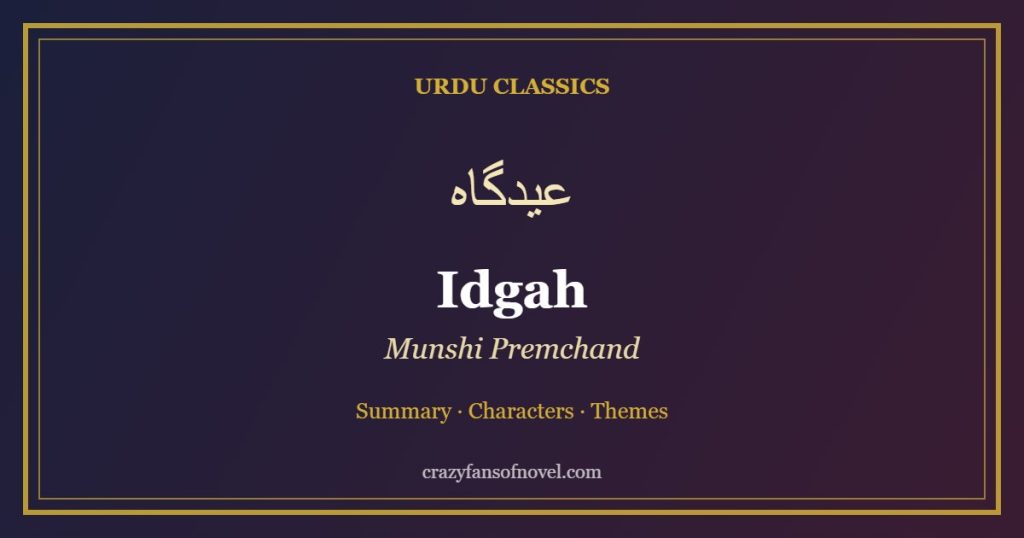
Idgah Summary: Premchand’s Eid Story, Characters and Moral
- Language
- Urdu
About this novel
Idgah (Urdu: عیدگاہ) is one of the best-loved short stories of Munshi Premchand. It is the story of a poor little orphan boy on the morning of Eid, and the gift he chooses with his last few coins. For generations it has been taught in schools across Pakistan and India, and it still makes readers cry.
In this guide
Summary of Idgah
Eid morning in the village
It is the morning of Eid, and the whole village is excited. The children are the happiest of all, counting the coins they have been given as Eidi and planning what they will buy at the fair near the Eidgah. Among them is Hamid, a small, thin boy of about four who lives with his grandmother Amina. His parents have died, though he has been told that his father has gone away to earn money and his mother has gone to Allah’s house to bring back gifts. Hamid has only three paise, but he is just as hopeful as the others.
Amina is worried. She has no money to make Eid special, and she is afraid to let such a small boy go to the crowded fair alone. But Hamid sets off with the other boys, full of joy.
At the fair
After the Eid prayer, the boys rush to the fair. Hamid’s friends spend their money on rides, sweets and clay toys: a soldier, a water-carrier, a lawyer. They tease Hamid and show off their treasures, but he does not spend his three paise on any of these things.
At a hardware stall he sees a pair of iron tongs (chimta). He remembers that his grandmother burns her fingers every day when she turns the rotis on the hot plate. He bargains hard and buys the tongs.
Winning the argument
The other boys laugh at him for buying such a dull thing. But Hamid defends his tongs so cleverly that one by one they admit the tongs are stronger and more useful than their fragile toys, which soon break. They even want to swap. Hamid refuses.
The ending
When Hamid gives the tongs to Amina, she is first angry that he spent his Eid money on something for her and bought nothing to eat. Then she understands why he chose them. The old woman bursts into tears and blesses him. Premchand writes that the child had become an old man, and the old woman a little child.
Characters
- Hamid: a poor orphan boy, wise and loving beyond his age.
- Amina: his grandmother, who raises him alone in poverty.
- Hamid’s friends: village boys with more money, who spend it on toys and sweets.
Themes and moral
- Love and sacrifice: a small child gives up his own pleasure to ease his grandmother’s pain.
- Poverty and dignity: Hamid has nothing, yet he keeps his self-respect and wins the argument.
- Practical wisdom: the useful gift outlasts the shiny toys.
The moral of Idgah is that true happiness comes from caring for others, not from spending on ourselves.
About Munshi Premchand
Premchand (1880–1936), born Dhanpat Rai Srivastava near Varanasi, is called the father of the modern Urdu and Hindi short story. He wrote hundreds of stories and several novels, first in Urdu and later in Hindi, about village life, poverty, honesty and the struggles of ordinary people.
Frequently asked questions
What did Hamid buy at the Eid fair? A pair of iron tongs (chimta) for his grandmother.
Why did he buy the tongs? Because his grandmother Amina burned her fingers every day while making rotis.
How much money did Hamid have? Three paise.
Read more guides in our Urdu Classics section, including Kafan by Premchand and Umrao Jaan Ada.
Ready to read Idgah Summary: Premchand's Eid Story, Characters and Moral?